

Looking for ways to support your wellness routine as the seasons change? Degree Wellness brings several technology-driven self-care treatments together in one modern wellness studio, including infrared sauna, IV vitamin drips, red light therapy, contrast therapy and oxygen therapy.
Each one is designed to support relaxation, recovery and overall well-being, and many guests combine two or three of them into a routine they keep up through the fall and winter. Here is what each service involves, what a visit looks like, and how guests tend to use them together.

How These Five Services Work Together
Each of these five services works differently, and that is the point of having them in one studio. Infrared sauna and contrast therapy work with temperature. Red light therapy and oxygen therapy work with light and air. IV vitamin drips deliver vitamins and antioxidants directly. Guests rarely use all five in a single visit. A more common pattern is one heat or cold service paired with one light or air service on the same day, with an IV drip added every few weeks. If you are building a routine around recovery and seasonal self-care, the Detox and Immunity benefits page groups these services by what guests are looking to support.
Infrared Sauna
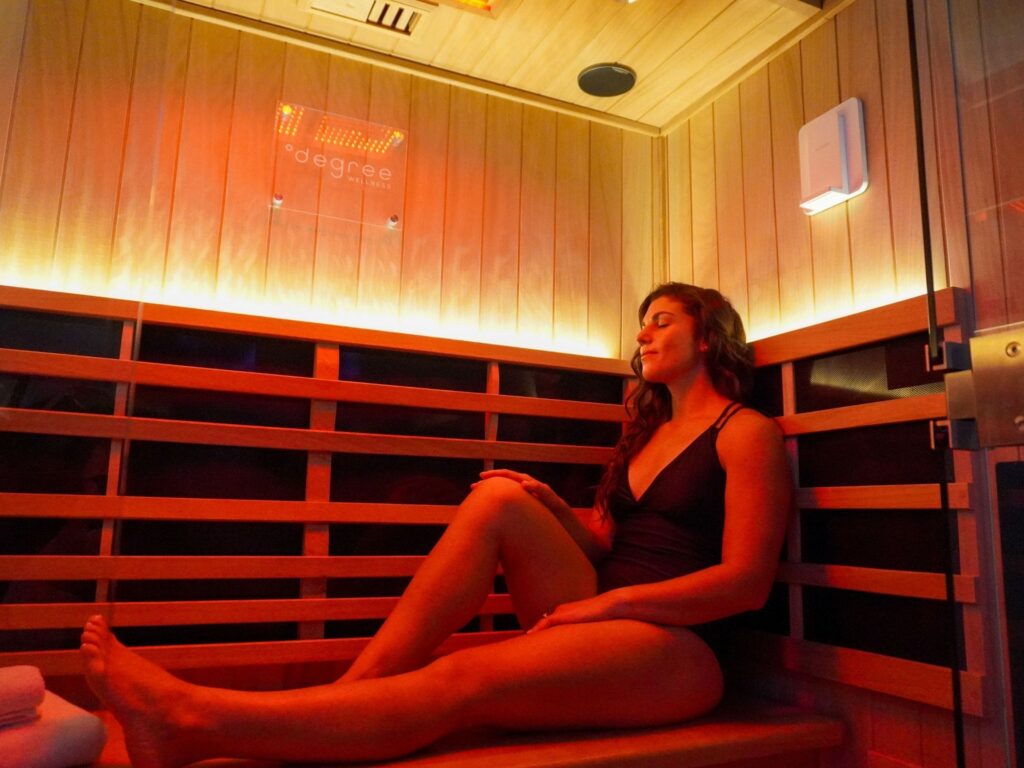
Infrared sauna uses gentle radiant heat to warm the body directly rather than heating the air around you, so a session feels comfortable at a lower room temperature.
Research on sauna bathing has looked at short-term changes in white blood cell counts in athletes and non-athletes, and findings like these are one reason many guests build regular heat sessions into a seasonal self-care routine. Infrared sauna is not a treatment for illness, and individual responses vary.
Many guests pair it with contrast therapy or a red light session in the same visit, and your studio can confirm how long a session runs and how often to book.
IV Vitamin Drips: Immunity and Detox
At Degree Wellness, our Immunity and Detox IV drip combines vitamin C and glutathione, with a B12 megadose and taurine added in the Pro option. The Immunity IV comes in two options: the Starter, which includes vitamin C and glutathione, and the Pro, which adds a B12 megadose and taurine. Vitamin C is an antioxidant that has been studied for its role in immune cell function and in protecting cells against oxidative stress [2]. B12 is a vitamin that has been studied for its role in red blood cell production and normal immune function [3]. Glutathione is an antioxidant that has been studied for its role in protecting cells from oxidative damage and in supporting the body’s detoxification pathways [3]. Taurine is an amino acid that has been studied for its role in gut health and immune cell activity, and it is often chosen as part of a seasonal wellness routine [4]. Many guests choose the Immunity and Detox IV drip as part of a wellness routine at Degree Wellness.
Red Light Therapy
Red light therapy, particularly red-to-near-infrared light, has shown promise in boosting immunity by modulating inflammatory processes [5]. This type of therapy stimulates healing, enhances mitochondrial function, improves blood flow, and increases tissue oxygenation [5]. Studies have demonstrated that R/NIR exposure often produces reactive oxygen species (ROS), nitrogen oxide (NO), and interleukins, all leading to a significant anti-inflammatory response [5]. The specific conditions, such as the light spectrum, irradiance, and exposure time, are crucial in determining the treatment’s effectiveness. At Degree Wellness we recommend 15 minutes as little as two to three times a week. By optimizing these parameters, R/NIR therapy can effectively reduce inflammation, making it one of several services guests combine in a recovery routine for enhancing immune function.

Contrast Therapy
Contrast therapy, which alternates between hot and cold treatments, is widely used in sports for recovery and offers benefits for immune function as well. The therapy can help reduce inflammation and muscle damage, as indicated by lower creatine kinase (CK) levels post-exercise [6]. These changes can enhance recovery and repair processes, promoting a quicker return to activity. Additionally, contrast therapy helps in lowering blood lactate concentrations, which is beneficial for muscle function. These physiological changes associated with contrast therapy suggest it can support the immune system by reducing inflammation and muscle stress [6].
Oxygen Therapy
Oxygen therapy is highly beneficial for immunity due to its significant role in cellular activities, especially within stem cells [7]. Oxygen acts as a vital signaling molecule, influencing the growth, maintenance, and differentiation of stem cells[7]. In low oxygen environments, stem cells increase the expression of genes involved in glycolysis, erythropoiesis, and angiogenesis [7]. This leads to the production of critical growth factors like vascular endothelial growth factor (VEGF), which promote new blood vessel formation and improve tissue oxygenation [7]. Additionally, low oxygen can stimulate stem cells to produce these growth factors more robustly, enhancing their ability to support immune function by promoting angiogenesis and reducing cell apoptosis. Therefore, oxygen therapy, by optimizing the oxygen levels in the cellular micro-environment, can boost the immune system through these regenerative and protective mechanisms [7].
Building a Seasonal Self-Care Routine
Consistency matters more than intensity. Most guests who keep a routine through fall and winter book one or two visits a week and keep the same services in rotation rather than trying something new each time. A simple starting point is one heat or contrast session and one red light session per week, with an IV drip or oxygen session added when schedules allow. Degree Wellness suggests about 15 minutes of red light therapy two to three times a week, and your studio can confirm frequency for the other services. Services and hours vary by location, so find a studio near you to see what is available. New guests can start with the intro offer and try a few services before settling into a weekly rhythm.
Frequently Asked Questions
What services does Degree Wellness offer for immune wellness?
Degree Wellness offers infrared sauna, IV vitamin drips, red light therapy, contrast therapy and oxygen therapy. Guests often combine two or three of them into one routine.
What is in the Immunity and Detox IV drip?
The Starter option includes vitamin C and glutathione. The Pro option adds a B12 megadose and taurine.
How often should I book red light therapy?
Degree Wellness suggests about 15 minutes, two to three times a week. Frequency for the other services should be confirmed with your studio.
Is contrast therapy the same as a cold plunge?
Contrast therapy alternates hot and cold in one session. Cold plunge is the cold side on its own, and Degree Wellness offers both.
Do these services replace medical care?
No. These are wellness and self-care services. They are not intended to diagnose, treat, cure or prevent any disease, and guests should speak with a healthcare professional about personal health questions.
Degree Wellness services are designed to support general wellness and self-care. They are not intended to diagnose, treat, cure or prevent any disease. Guests should consult a qualified healthcare professional before beginning any new wellness therapy.
References
- Pilch, W., Pokora, I., Szyguła, Z., Pałka, T., Pilch, P., Cisoń, T., Malik, L., & Wiecha, S. (2013). Effect of a single Finnish sauna session on white blood cell profile and cortisol levels in athletes and non-athletes. Journal of Human Kinetics, 39, 127–135. https://johk.pl/?p=2754
- Carr, A. C., & Maggini, S. (2017). Vitamin C and immune function. Nutrients, 9(11), 1211. https://www.mdpi.com/2072-6643/9/11/1211
- National Institutes of Health. (n.d.). Vitamin B12 – Health Professional. Office of Dietary Supplements. https://ods.od.nih.gov/factsheets/VitaminB12-HealthProfessional/
- Fang, H., Meng, F., Piao, F., Jin, B., Li, M., & Li, W. (2019). Effect of taurine on intestinal microbiota and immune cells in Peyer’s patches of immunosuppressive mice. Advances in Experimental Medicine and Biology, 1155, 13-24. https://link.springer.com/chapter/10.1007/978-981-13-8023-5_2
- Walski, T., Dąbrowska, K., Drohomirecka, A., Jędruchniewicz, N., Trochanowska-Pauk, N., Witkiewicz, W., & Komorowska, M. (2019). The effect of red-to-near-infrared (R/NIR) irradiation on inflammatory processes. International Journal of Radiation Biology. https://www.tandfonline.com/doi/full/10.1080/09553002.2019.1625464
- Hing, W. A., White, S. G., Bouaaphone, A., & Lee, P. (2008). Contrast therapy—A systematic review. Physical Therapy in Sport, 9(3), 148-161. https://linkinghub.elsevier.com/retrieve/pii/S1466853X08000679
- Abdollahi, H., Harris, L. J., Zhang, P., McIlhenny, S., Tulenko, T., & DiMuzio, P. J. (2011). The role of hypoxia in stem cell differentiation and therapeutics. Journal of Surgical Research, 165(1), 112-117. https://linkinghub.elsevier.com/retrieve/pii/S0022480409005198