

Living with a chronic skin condition can feel like a loop: inflammation, itching, redness, disrupted sleep. Then a flare that resets the clock. If you’re managing eczema, psoriasis, or rosacea, you’ve probably tried multiple approaches: moisturizers, trigger tracking, prescription creams, and lifestyle changes.
Red Light Therapy (RLT) is a popular, non-invasive option many people add to their routine to support skin comfort and overall wellness. While it’s not a cure and results vary, it may be a helpful complement to a dermatologist-led care plan, especially for inflammation, irritation, and skin recovery.
Quick Reader’s Summary
- What it is: Red Light Therapy (also called photobiomodulation or low-level light therapy) uses red (and sometimes near-infrared) light to support cellular function and tissue recovery. [4]
- Why people use it for skin: Many people try RLT for redness, irritation, and signs of skin stress or aging. [4]
- What the research says: Early research suggests red/near-infrared light may support anti-inflammatory processes and skin healing, but evidence varies by condition and more high-quality human studies are still needed. [4]
- What to expect: Most people start with short sessions (often ~10–15 minutes) a few times per week for several weeks, then adjust based on response. [4]
- Bottom line: RLT can be a low-downtime, low-discomfort add-on for skin wellness, especially when paired with good skincare habits and medical guidance.
What Is Eczema (Atopic Dermatitis), and Why Treat It?
Eczema, also known as atopic dermatitis, is a chronic inflammatory skin condition most commonly linked with dryness, itching, and a weakened skin barrier. It’s sometimes called the “itch that rashes” because scratching can intensify the flare and increase irritation. [1]
Why treating eczema matters:
- Comfort and sleep: Itching is often the most burdensome symptom and can interfere with sleep. [3]
- Skin barrier and infection risk: Cracked or inflamed skin can become more vulnerable to infection. [1]
- Quality of life: Flares can affect work, focus, and confidence. [3]
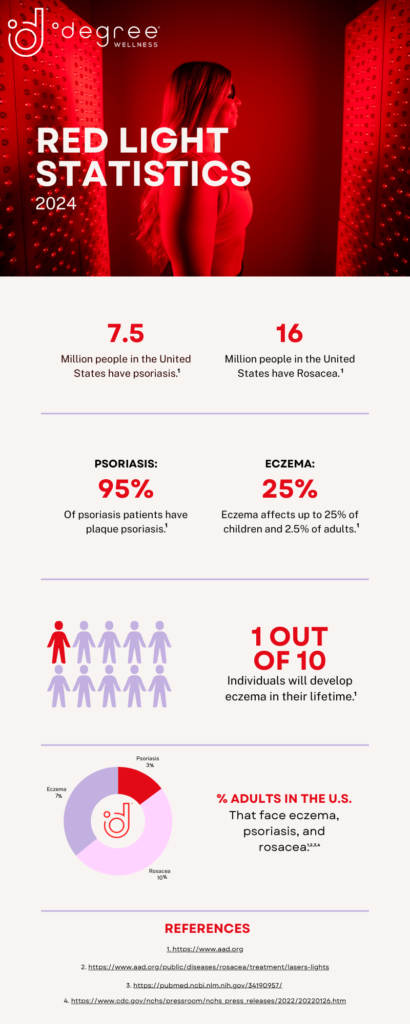
Eczema is common. U.S. estimates vary, but national data suggests around 7.3% of adults report being diagnosed, with higher prevalence in women in some surveys. [2] Many people develop symptoms in childhood, though it can continue into adulthood or begin later. [3]
What Is Psoriasis, and Why Treat It?
Psoriasis is a chronic immune-mediated condition that speeds up skin cell turnover, which can lead to thicker, inflamed patches and scaly plaques. [6]
Why treating psoriasis matters:
- Symptoms can be persistent: Itch, discomfort, visible plaques, and disrupted sleep can be significant. [6]
- Whole-body health: Psoriasis can be associated with other conditions, including psoriatic arthritis and increased cardiovascular risk. [6]
- Mental wellbeing: Chronic visible symptoms can impact stress levels and confidence. [6]
In the U.S., psoriasis affects millions of people and is most common in adults. [6,7] The most common type is plaque psoriasis. [6,7]
What Is Rosacea, and Why Treat It?
Rosacea is a chronic inflammatory skin condition most often seen as persistent facial redness, flushing, and sometimes bumps or sensitivity – often concentrated around the cheeks and nose. [8]
Why treating rosacea matters:
- Symptoms can worsen over time without management. [8]
- Some subtypes can involve skin thickening or eye involvement (ocular symptoms), which should be addressed promptly. [8]
Rosacea affects millions of Americans and is most commonly diagnosed in adults. [7,8] Triggers vary by person and often include things like heat, sun exposure, stress, and certain skincare ingredients. [8]
What Is Red Light Therapy?
Red Light Therapy (RLT) uses low-wavelength red light (and sometimes near-infrared light) applied to the skin to support tissue recovery and overall skin wellness. You may also hear it called:
- photobiomodulation
- low-level light therapy
- low-level laser therapy (LLLT) (some studies use lasers; many wellness settings use LED panels)
In simple terms, red and near-infrared light may help support the body’s natural repair processes by influencing cellular activity (often described in relation to mitochondrial function), circulation, and inflammation pathways. [4]
RLT is commonly used for:
- visible signs of skin stress or aging (fine lines, texture changes)
- general skin recovery support
- muscle and joint comfort and overall wellness routines (in some settings)
Can Red Light Therapy Help My Skin Condition?
The most helpful way to think about RLT is as a supportive tool, not a replacement for medical treatment. If you have eczema, psoriasis, or rosacea, it may help with inflammation and recovery, but it shouldn’t be positioned as a cure.
Below is a condition-by-condition view.
Red Light Therapy for Eczema
For eczema, the goal is usually to calm inflammation, reduce itch, and support the skin barrier alongside foundational care (moisturizing, trigger management, and medical therapies when needed). [1]
What RLT may support (based on emerging research):
- inflammation management
- skin comfort and recovery
- reduced irritation during mild-to-moderate flare cycles (individual results vary)
Important note on evidence:
- Some research includes preclinical models (for example, animal-model studies exploring inflammatory markers). [5]
- Human evidence is still developing, and responses can differ widely based on eczema severity, triggers, and routine consistency. [4]
Red Light Therapy for Psoriasis
Psoriasis treatment is very individualized and can include topical treatments, systemic medications, and dermatology-guided phototherapy (most commonly UV-based options like NB-UVB). [6,9]
How RLT fits in:
- RLT is not the same as UV phototherapy used in dermatology (UV is a different wavelength range and is typically prescribed/monitored for psoriasis). [9]
- Many people explore RLT as a complementary wellness tool for inflammation support, comfort, and skin recovery, especially when combined with a medical plan. [4]
If you have psoriasis and are considering light-based therapies, it’s smart to ask:
- Which light therapy is best for my type and severity?
- Is UV phototherapy recommended for me?
- Can I safely combine RLT with my current regimen?
Red Light Therapy for Rosacea
Rosacea can involve different features – persistent redness, flushing, visible blood vessels, bumps, and sensitivity – so treatments vary. [8]
Where people sometimes use RLT:
- general redness/inflammation support
- soothing routines paired with gentle skincare (results vary)
Important clarification (to avoid confusion):
- When rosacea is driven by visible blood vessels, dermatologist-directed laser or light treatments (such as vascular lasers or IPL) are often used. The American Academy of Dermatology notes many patients see a noticeable reduction in visible blood vessels after a short series of treatments. [10]
- That statistic applies to medical laser/light treatments for blood vessels, not necessarily to red LED wellness panels.
If your main concern is visible vessels, persistent flushing, or eye symptoms, a dermatologist evaluation is the best next step. [8,10]
Safety, Side Effects, and Who Should Avoid Red Light Therapy
Red light therapy is generally considered low-risk when used appropriately, but “low-risk” doesn’t mean “right for everyone.” [4]
Possible short-term effects (usually mild):
- temporary warmth or redness
- dryness or sensitivity (especially if your skin barrier is already compromised)
- occasional headache or eye discomfort if light is too bright or eye protection isn’t used
Check with a healthcare provider first if you:
- are taking medications that increase light sensitivity
- have a history of seizures triggered by light
- have a history of skin cancer or suspicious lesions
- are pregnant or have a medical condition where light exposure should be supervised
- have moderate-to-severe eczema/psoriasis/rosacea that is flaring heavily (you may need medical stabilization first)
And no matter what: RLT should complement – not replace – your medical treatment plan. [4,6,8]
Why Choose Red Light Therapy at Degree Wellness?
At Degree Wellness, our red light therapy sessions are designed to be simple, comfortable, and consistent because consistency is what usually drives results with wellness-based routines.
What makes our experience different:
- Full-body exposure: Our system is designed for broad coverage rather than only treating one small area at a time.
- Efficient sessions: Most sessions are about 15 minutes, making it easy to fit into a weekly routine.
- Supportive environment: We’ll help you get set up comfortably and answer questions so you know what you’re doing and why.
A practical approach we recommend:
Think of RLT as one piece of a bigger skin plan: gentle skincare + hydration + trigger awareness + medical guidance when needed. [1,6,8]
Ready to try it?
If you’re exploring non-invasive ways to support calmer, healthier-looking skin, Degree Wellness can help you build a routine you can stick with.
What to Expect at Your First Session
- Quick intake + goal setting
We’ll ask what you’re focusing on: eczema discomfort, redness, irritation, recovery support, or general skin wellness. - Get set up comfortably
You’ll position yourself for even exposure. Eye protection is recommended. - Your session (typically ~15 minutes)
Most people describe the experience as warm and relaxing. - Suggested frequency
Many people start at 1–3 sessions per week for several weeks, then adjust based on how their skin responds and what they’re pairing it with. [4]
FAQs: Red Light Therapy for Eczema, Psoriasis, and Rosacea
Is red light therapy a cure for eczema, psoriasis, or rosacea?
No. These are chronic conditions and typically require long-term management. RLT may be a helpful supportive option for some people, but it is not a cure. [1,6,8]
How many sessions does it take to see results?
It varies. Many people try a consistent schedule for several weeks before judging results. Some notice changes sooner; others need longer. [4]
Can I use red light therapy during a flare?
Sometimes, but it depends on how reactive your skin is. If you’re in a severe flare (especially with broken skin, infection concerns, or intense burning), consult your clinician first and consider stabilizing the flare before adding new therapies. [1,4]
Is red light therapy the same as UV phototherapy for psoriasis?
No. UV phototherapy (like NB-UVB) is a medical treatment approach commonly used for psoriasis under clinical guidance. Red light therapy uses different wavelengths and is usually approached as supportive wellness care. [6,9]
Can red light therapy help rosacea blood vessels?
Visible blood vessels are often treated with dermatologist-directed laser/light procedures (like vascular lasers or IPL). RLT may support general redness/inflammation for some people, but it’s not the same type of treatment as vascular laser therapy. [8,10]
Are there side effects?
RLT is typically well-tolerated, but some people experience temporary redness, dryness, or sensitivity. Always use sessions as directed and ask your provider if you take photosensitizing medications. [4]
Can I combine red light therapy with topical creams or prescription treatment?
Often yes, but timing matters and skin sensitivity varies. It’s best to follow your clinician’s guidance, especially if you’re using prescriptions for eczema, psoriasis, or rosacea. [1,6,8]
Who should avoid red light therapy?
Anyone with a medical condition involving light sensitivity, certain medication use, or a history that needs supervision should check with a clinician first. If unsure, ask your dermatologist or healthcare provider. [4]
References
- Nemeth, V., Syed, H. A., & Evans, J. (2024). Eczema. StatPearls. StatPearls Publishing. Retrieved from: https://www.ncbi.nlm.nih.gov/books/NBK538209
- Ng, A. E., & Boersma, P. (2023). Diagnosed allergic conditions in adults: United States, 2021 (NCHS Data Brief No. 460). U.S. Department of Health and Human Services, CDC, NCHS. https://www.cdc.gov/nchs/data/databriefs/db460.pdf
- National Eczema Association. (2021). Eczema facts. Retrieved July 5, 2024, from https://nationaleczema.org/research/eczema-facts/
- Cleveland Clinic. (2024). Red Light Therapy. https://my.clevelandclinic.org/health/articles/22114-red-light-therapy
- Kim, Y. L., Lim, H. S., & Lee, S. M. (2021). Effect of low-level laser intervention on dermatitis symptoms and cytokine changes in DNCB-induced atopy mouse model. Experimental and Therapeutic Medicine, 22(5), 1196. https://doi.org/10.3892/etm.2021.10630
- National Institute of Arthritis and Musculoskeletal and Skin Diseases. (2024). Psoriasis. U.S. Department of Health and Human Services. https://www.niams.nih.gov/health-topics/psoriasis
- American Academy of Dermatology. (2024). Skin conditions by the numbers. https://www.aad.org/media/stats-numbers
- National Institute of Arthritis and Musculoskeletal and Skin Diseases. (2024). Rosacea. Retrieved July 10, 2024, from https://www.niams.nih.gov/health-topics/rosacea
- Zhang, P., & Wu, M. X. (2018). A clinical review of phototherapy for psoriasis. Lasers in Medical Science, 33(1), 173–180. https://doi.org/10.1007/s10103-017-2360-1
- American Academy of Dermatology. (2024). Lasers and lights: How well do they treat rosacea? Retrieved July 10, 2024, from https://www.aad.org/public/diseases/rosacea/treatment/lasers-lights